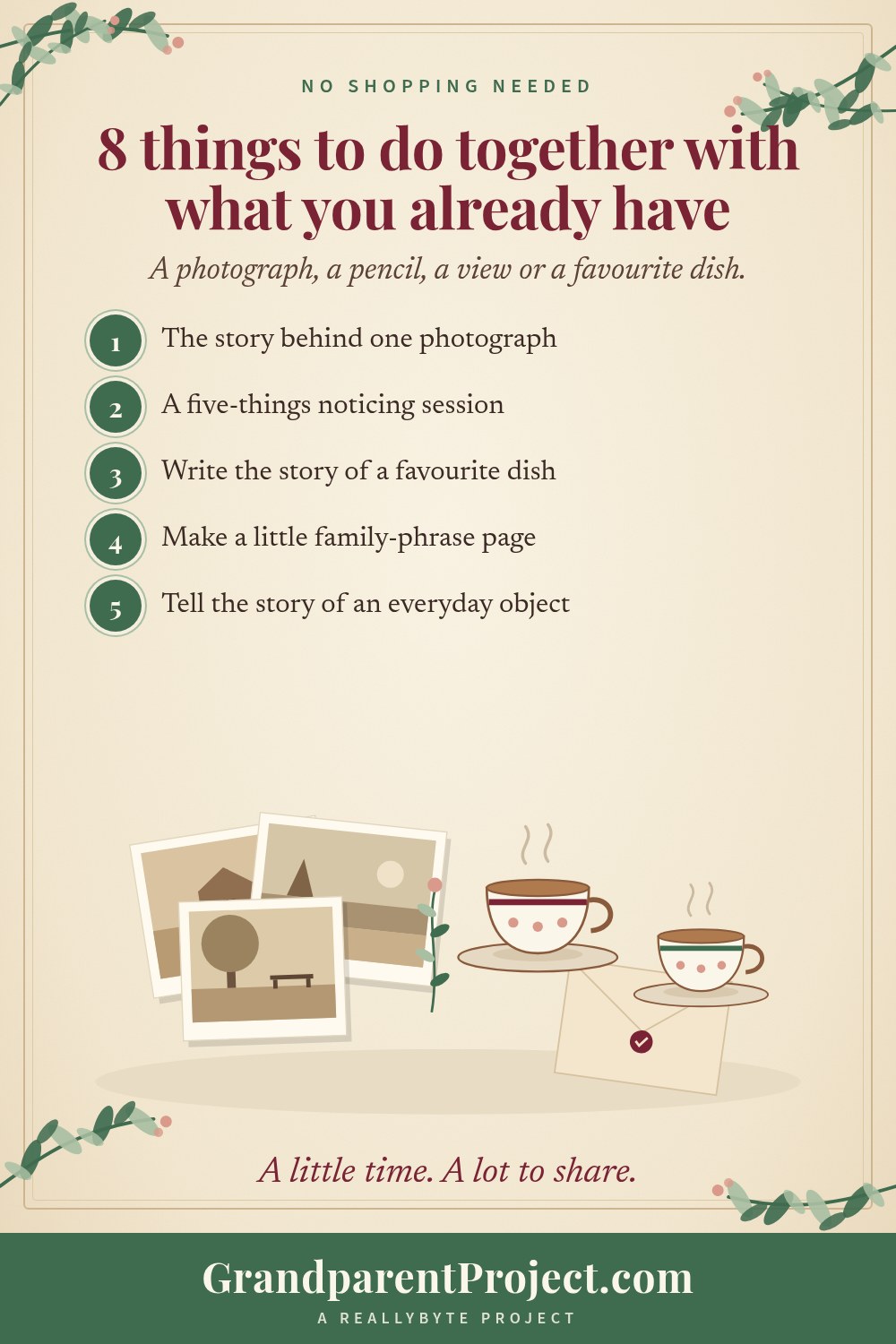
One picture, one willing storyteller and a few details that can stay with the image.
Bring or find: A photograph its owner is comfortable discussing; paper is optional.
Invite the owner to choose one picture, rather than handing over a whole stack.
Ask what they would like you to know about it. Follow one detail they mention.
If they want a note kept, write their wording and mark anything uncertain. Agree who may see it.
A way to adapt it: Use a large copy or describe the image aloud if that suits the people taking part. No need to identify every face.
2
Make · Longer · Use what you have
Draw a map of a familiar place
A rough map with personal landmarks: the corner shop, a good shortcut or a place everyone met.
Bring or find: Paper and a pen or pencil.
Agree on a place you both enjoy talking about. Start with one landmark.
Add a few routes or places and let each person explain what belongs there. Accuracy is optional.
Give the map a title and mark who contributed. Keep it only if everyone wants to.
A way to adapt it: One person can draw while the other describes. Stop at a few landmarks rather than trying to complete a town.
3
Talk · Short · Use what you have
A five-things noticing session
Look at the view together and choose five small things you might otherwise pass by.
Bring or find: A comfortable spot with a view, indoors or somewhere suitable outside.
Choose the place together. There is no need to travel or walk a particular distance.
Take turns pointing out a colour, movement, shape or other detail that catches your attention.
Choose a favourite observation and, if you like, give the session a small title.
A way to adapt it: Describe what you notice, use fewer than five observations or swap the view for familiar objects on a table.
4
Make · Longer · Use what you have
Write the story of a favourite dish
Capture why a dish matters without turning the visit into a cooking session.
Bring or find: Paper and a pen; an existing recipe if its owner wants to use it.
Ask which dish they would enjoy talking about and where it belongs in their life.
Write the name, the person associated with it and a short story in their own words.
If adding ingredients or a method, mark any missing details rather than inventing them. Agree how the card will be shared.
A way to adapt it: Make a story card only; no cooking or tasting is required. If you cook later, check food-safety guidance, ingredients and individual dietary needs separately.
5
Talk · Short · Use what you have
Take turns with a short reading
A paragraph, a favourite book page or something you have written yourself.
Bring or find: A reading both people want to hear, in a usable format.
Choose a short section rather than committing to a chapter.
Decide whether to take turns, have one reader or listen to a suitable recording you already have.
Ask what caught each person’s attention. Different reactions make the conversation interesting.
A way to adapt it: Read aloud, increase text size where possible or choose a familiar piece. There is no need to explain or memorise it.
6
Make · Short · Use what you have
A tiny garden-view sketch
Draw one plant shape or garden detail, from a seat outside or an indoor view.
Bring or find: Paper and a pencil; a suitable spot you can use comfortably.
Pick a single shape or detail, without needing to identify or handle the plant.
Draw for a few minutes, or let one person describe while the other sketches.
Compare what each person noticed and give the drawings a date or title if wanted.
A way to adapt it: Use a photograph, a view through the window or any familiar object. Do not taste plants or collect unidentified materials.
7
Talk · Short · Use what you have
Make a little family-phrase page
The sayings, nicknames or expressions that sound like home to the people involved.
Bring or find: Paper or a notebook, if you want to keep a page.
Invite one expression with a story that feels comfortable to tell.
Ask how it was used and whether different family members remember it differently.
Write the expression and a short explanation, then ask whether it is okay to keep or repeat it.
A way to adapt it: Skip phrases linked to unwelcome memories or private details. Current jokes and new traditions are welcome too.
8
Talk · Short · Use what you have
Tell the story of an everyday object
A familiar object can open a conversation about a skill, a person or a project.
Bring or find: An ordinary object its owner is happy to discuss.
Ask the owner to select an object, rather than assuming an heirloom is available.
Invite the story of how it is used or why it stayed. Ask one follow-up about their answer.
If wanted, make a photo-and-caption note with permission. Leave the object where it belongs.
A way to adapt it: Describe the object or use a photograph. Avoid handling fragile, sharp, valuable or otherwise unsuitable items.
$4.99 USD · digital download · 11 pages, A4 + US Letter
The Year You Were Born Interview Pack
Their memories of a chosen year, in their words: 15 interview prompts, a facts-and-memories page, then and now, a timeline and a letter from that year.
Our conversation ideas, activities and planning tools are free to explore. If they’ve helped you make a little time together, you can support the site with our digital thank-you badge.
 A little time. A lot to share.